Bishop Robert Barron wrote an article for First Things magazine in the May 12, 2025 edition titled Francis in Full. In the article, Bishop Barron assesses where the Church is now after the Pope Francis pontificate. He begins by listing the positive things that he felt we have received from Pope Francis, including his very first apostolic exhortation, Evangelii Gaudium. He also mentions that there are some big challenges that came about with Pope Francis that will be difficult for Pope Leo to address.
In his article, Bishop Barron says,
What I find perhaps most intriguing about Pope Francis is what he didn’t do. . . . When it became clear that Francis in fact leaned to the port side of the ideological spectrum, many on the Catholic left commenced to see him as the long-awaited liberal savior . . . . Francis, they were convinced, would, at long last, bring us . . . a liberalizing of the Church’s teachings on abortion, homosexuality, transgenderism, and birth control. Well, he delivered on precisely none of it.
Here, Bishop Baron addresses how the very hopes that Pope Francis raised amongst those who want to see the Church teaching change in all these critical areas have left a real wound in the Church. A lot of people who did not really believe what the Church teaches surfaced and felt bold enough to declare that was the case. So even though Pope Francis himself never came to the point of changing Church teaching, he led a lot of people to believe that that was where he was heading.
Bishop Barron continues in explaining the difficulties of that:
What one reads in almost every assessment of the late pope is that he was, at the very least, “controversial,” “confusing,” “ambiguous.” . . . Pope Francis was a puzzling figure in many ways, seeming to delight in confounding expectations, zigging when you thought he would zag.
One of the messier moments of the Francis pontificate was the two-part Synod on the Family . . . The fact that Walter Cardinal Kasper, a long-time advocate of allowing divorced and remarried Catholics to receive communion, spoke at the outset of the gathering indicated rather clearly the direction that Pope Francis wanted the synod to take. But he was met with stiff resistance from bishops, . . . and when the final document appeared, the famous Amoris Laetitia, the question seemed oddly unresolved, open to a variety of interpretations.
In many ways, that is where we are today. People are interpreting what Pope Francis said and did, and sometimes in quite opposite directions. This is a serious evaluation that Bishop Barron is giving here, and it shows the tremendous challenge facing Pope Leo in dealing with this division and working to bring unity.
We know that Pope Leo wants to try to bridge the polarization that has manifested itself in the papacy and in the Church. Whole bishops’ conferences are advocating for changes in our teaching that cannot change. There are a lot of people throughout the Church in positions of high responsibility who are in that same camp, and there are others that are saying, “No, we can’t go there.” This is a tremendously difficult task, and it is very important because the ability of the Catholic Church to talk with one voice, to proclaim the Gospel without compromise, and to strengthen people who are caught up in the confusion of our culture is hanging in the balance. We need to ask God to give the Church a clear voice to be able to speak the truth in love.
This article is condensed from Ralph Martin’s YouTube video entitled Bishop Barron, Francis’ Legacy, and Challenges Facing Pope Leo. It originally appeared in Renewal Ministries’ January 2026 newsletter.
 rmartin@renewalministries.net
 Download Headshot 1 (JPG, 2MB)
 Download Headshot 2 (JPG, 2MB)
 Download Biography (PDF, 65KB)











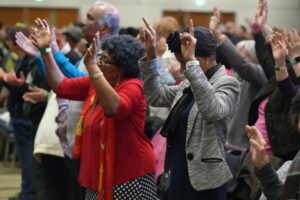
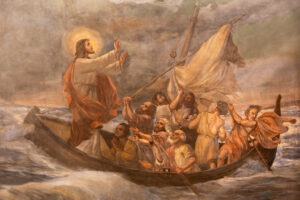








One can readily be confused and feel discouraged in this day of the instantaneous, twenty-four hour news cycle. Perhaps one can simply say, it’s sensory overload. That can apply to our life in the Spirit as well. In my case, I am trying, in the face of all the division and adversity we are witnessing, to step back and tell myself: This is all part of God’s plan. Trust Him; He’s got the helm in this turbulent storm. I find great comfort in this knowledge, because it changes my perspective from self-centered to God-centered.